HEALTH
Hong Kong has the world's longest life expectancy
Life expectancy at birth in Hong Kong reached 85.4 years in 2024, more than a decade above the world average. Here's how it compares.
The short answer
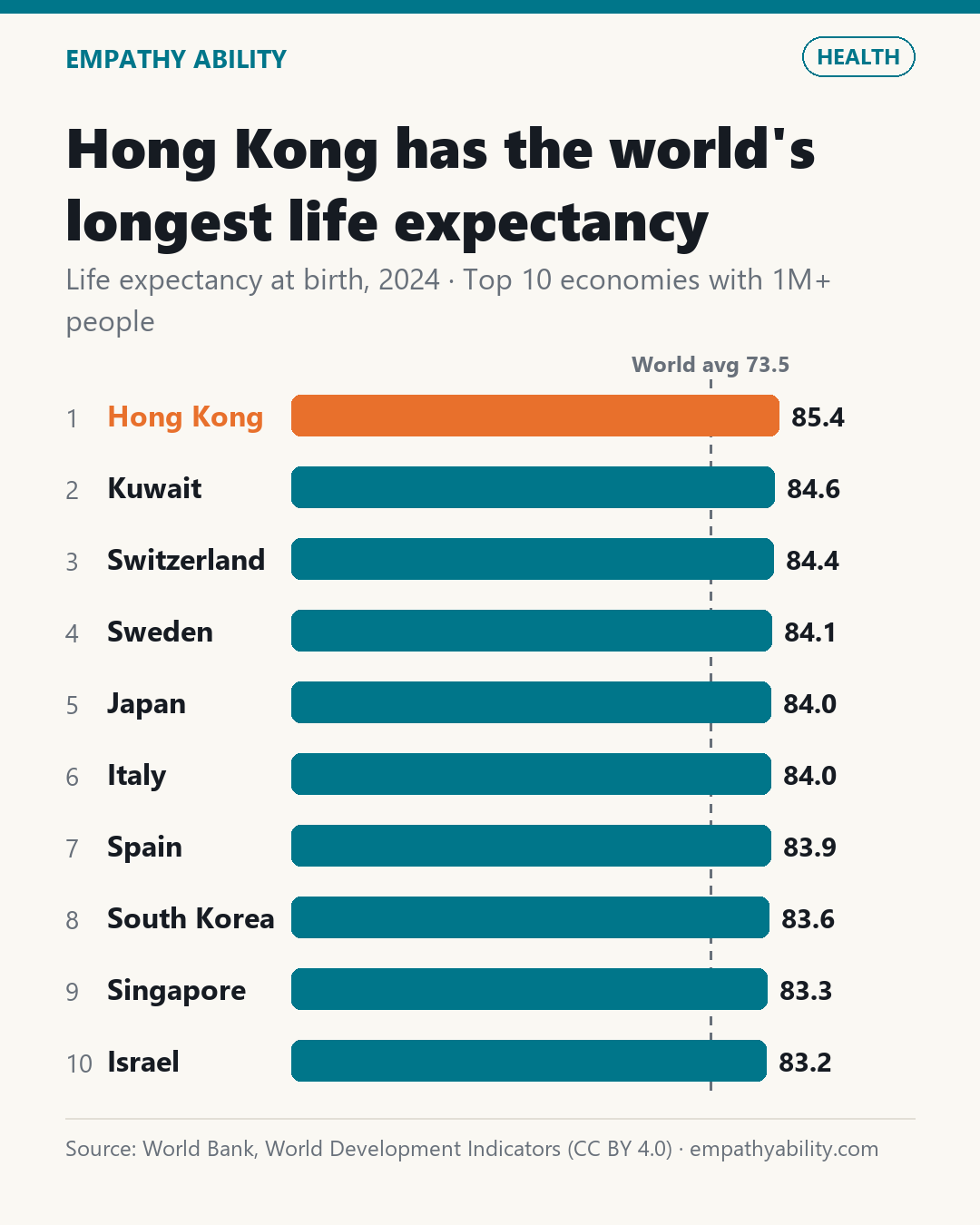
Hong Kong has the highest life expectancy at birth of any economy with more than one million people: 85.4 years in 2024, according to World Bank data. Kuwait (84.6), Switzerland (84.4) and Sweden (84.1) follow. The world average is 73.5.
The full top 10
| Rank | Country / economy | Life expectancy (years) |
|---|---|---|
| 1 | Hong Kong | 85.4 |
| 2 | Kuwait | 84.6 |
| 3 | Switzerland | 84.4 |
| 4 | Sweden | 84.1 |
| 5 | Japan | 84.0 |
| 6 | Italy | 84.0 |
| 7 | Spain | 83.9 |
| 8 | South Korea | 83.6 |
| 9 | Singapore | 83.3 |
| 10 | Israel | 83.2 |
What the number means
Life expectancy at birth estimates how long a baby born today would live if death rates at every age stayed the same as they are now. It reflects healthcare quality, nutrition, safety and public health together, not any single factor.
Where the longest lives are
Six of the top ten are in East Asia and the Middle East (Hong Kong, Japan, South Korea, Singapore, Kuwait, Israel); the rest are in Europe (Switzerland, Sweden, Italy, Spain). South Korea ranks 8th at 83.6 years.
Why it matters
A gap of a decade or more between the highest- and lowest-ranked economies mostly comes down to access to basic healthcare, clean water and safety from preventable causes of death — not wealth alone. Several lower-income economies outperform much richer ones on this measure.
How we made this
Data: World Bank, World Development Indicators (indicator SP.DYN.LE00.IN), latest available year (2024). We compare economies with at least one million people.
Frequently asked questions
What is the lowest life expectancy in the world?
Among economies with at least one million people, Nigeria (54.6), Chad (55.2) and the Central African Republic (57.7) have the lowest life expectancy (2024).
Why does Hong Kong rank so high?
Researchers commonly point to universal healthcare access, low smoking rates among women, and a diet relatively low in red meat, though no single factor fully explains the gap.