ENERGY
Why the world's top 'renewable energy' countries are among its poorest
The countries with the highest share of renewable energy in their final energy consumption are mostly among the world's poorest — because the measure counts firewood and charcoal, not just solar and wind.
The short answer
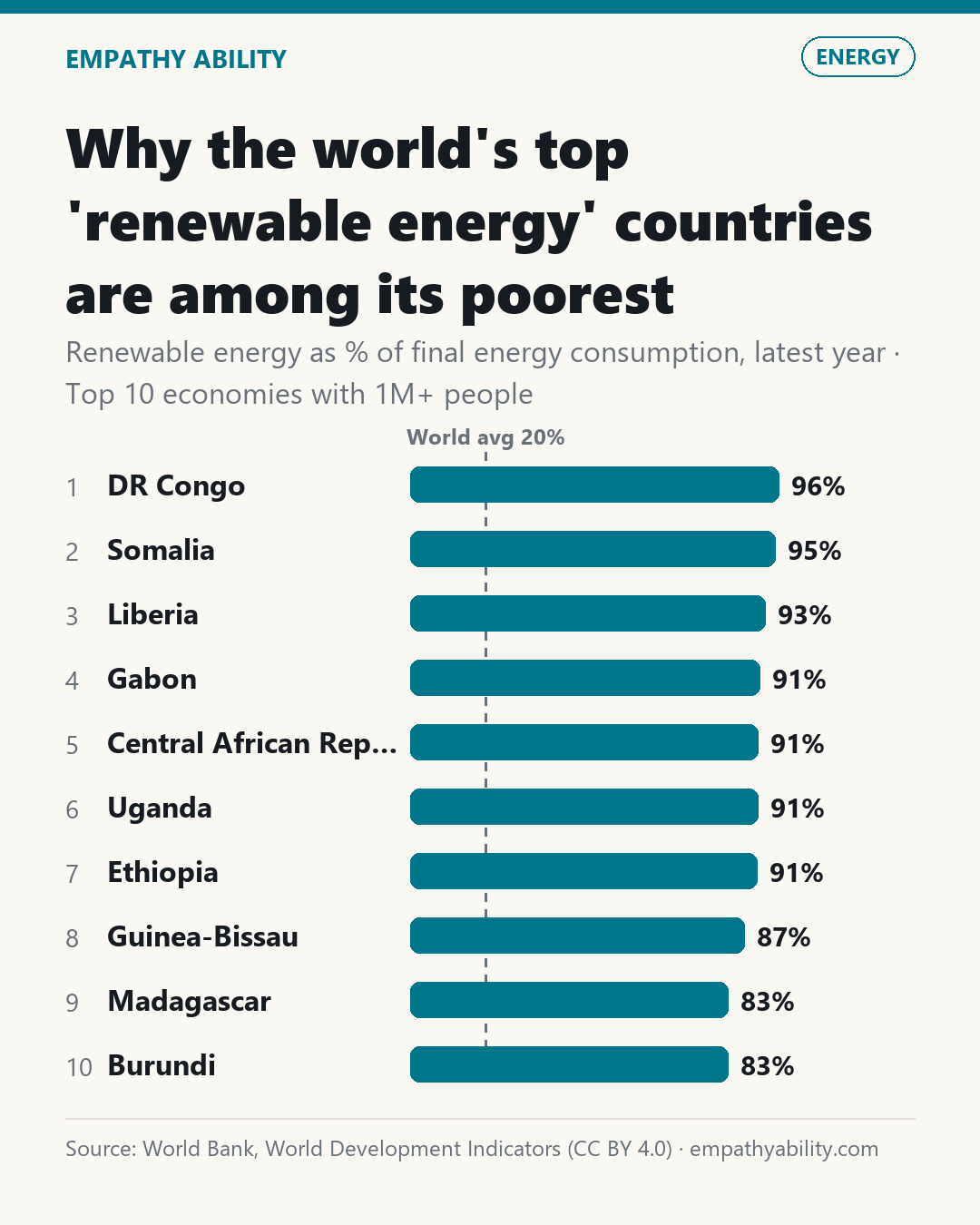
The economies with the highest renewable energy share are DR Congo, Somalia, Liberia, Gabon and the Central African Republic — all above 90% — according to World Bank data. The world average is about 20%. South Korea, despite its solar and wind investment, ranks near the bottom of this particular list.
The full top 10
| Rank | Country / economy | Renewable energy (% of final consumption) |
|---|---|---|
| 1 | DR Congo | 96% |
| 2 | Somalia | 95% |
| 3 | Liberia | 93% |
| 4 | Gabon | 91% |
| 5 | Central African Republic | 91% |
| 6 | Uganda | 91% |
| 7 | Ethiopia | 91% |
| 8 | Guinea-Bissau | 87% |
| 9 | Madagascar | 83% |
| 10 | Burundi | 83% |
What the number means
This indicator measures renewable energy as a share of total final energy consumption. Crucially, it counts traditional biomass — firewood, charcoal and animal waste burned for cooking and heating — as renewable, alongside solar, wind, hydro and modern biofuels.
Where the highest shares are
The top ten are almost entirely low-income Sub-Saharan African economies: DR Congo, Somalia, Liberia, Gabon, Central African Republic, Uganda, Ethiopia, Guinea-Bissau, Madagascar and Burundi. In these countries, a large share of households still cook over open wood fires because they lack access to electricity or modern fuels — which this indicator counts the same way it counts a solar panel.
Why it matters
Confusing 'high renewable share' with 'clean, modern energy' can create a misleading picture. Traditional biomass burning has real costs — indoor air pollution, deforestation, and time spent gathering fuel — that a solar or wind installation doesn't. Countries actually leading in modern, zero-carbon electricity, like Norway, Iceland and Paraguay with their hydropower, don't necessarily top this particular ranking because it measures the whole energy mix, not just electricity generation.
How we made this
Data: World Bank, World Development Indicators (indicator EG.FEC.RNEW.ZS), latest available year per economy (2021–2022). We compare economies with at least one million people.
Frequently asked questions
Does this mean these countries are climate leaders?
Not necessarily — the measure includes traditional biomass burning, which has significant health and deforestation costs and isn't the same as modern solar, wind or hydro power.
Which countries lead in modern renewable electricity instead?
Countries like Norway, Iceland and Paraguay generate almost all of their electricity from hydropower — a more specific measure than this indicator, which covers all final energy use.