ECONOMY
Where women make up most of the workforce — and it's not the richest countries
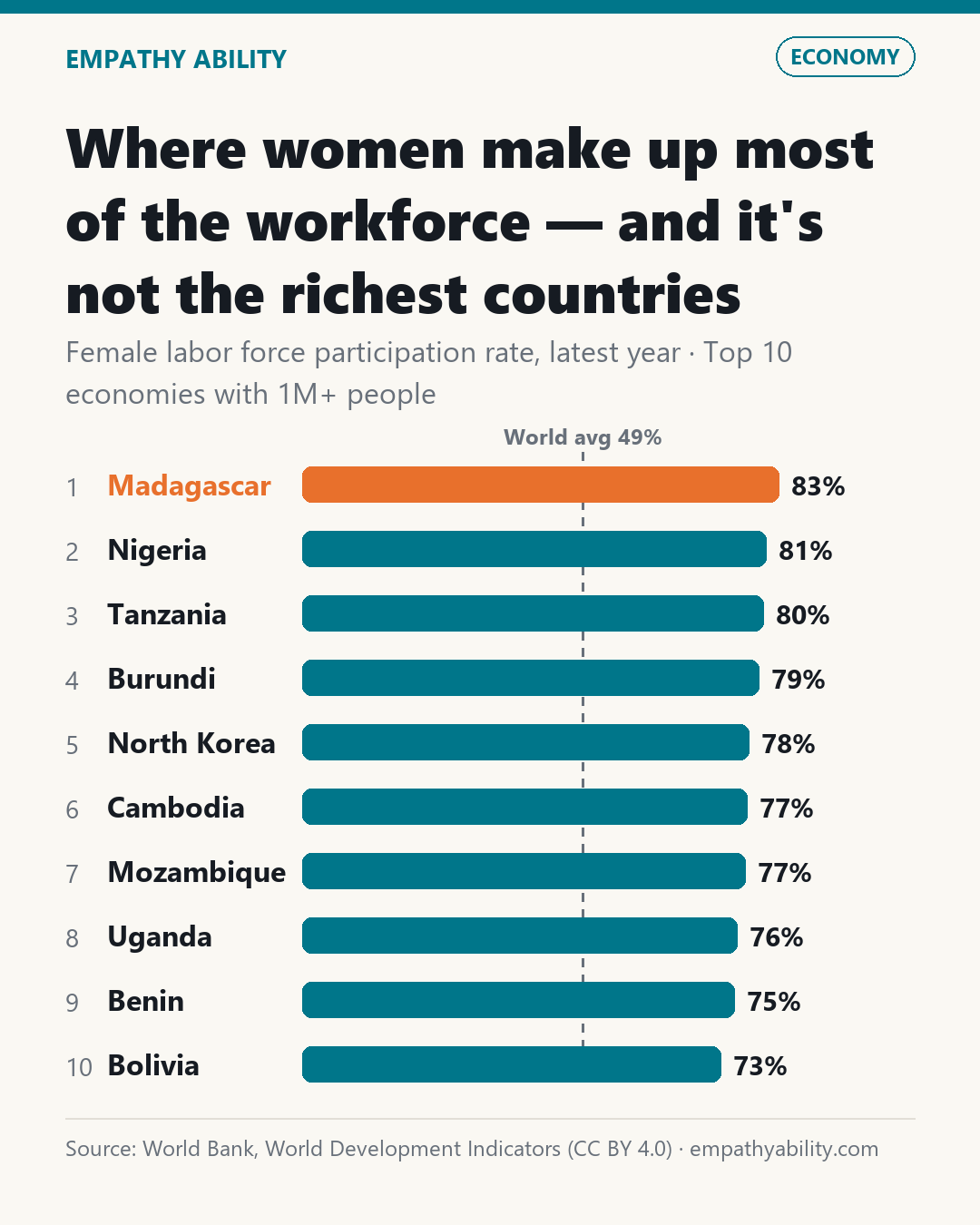
In Madagascar, more than 4 in 5 women are in the labor force — the highest rate in the world. The pattern shows up mostly in lower-income, agriculture-heavy economies.
The short answer
Madagascar has the world's highest female labor force participation rate among economies with more than one million people, followed by Nigeria and Tanzania — all above 80%. The world average is about 49%. South Korea, at around 57%, ranks above the world average but in the middle of the global pack.
The full top 10
| Rank | Country / economy | Female labor force participation (%) |
|---|---|---|
| 1 | Madagascar | 83% |
| 2 | Nigeria | 81% |
| 3 | Tanzania | 80% |
| 4 | Burundi | 79% |
| 5 | North Korea | 78% |
| 6 | Cambodia | 77% |
| 7 | Mozambique | 77% |
| 8 | Uganda | 76% |
| 9 | Benin | 75% |
| 10 | Bolivia | 73% |
What the number means
This measures the share of women aged 15 and older who are working or actively looking for work, based on modeled ILO estimates.
Where the highest rates are
The top of the list is dominated by lower-income economies in Sub-Saharan Africa and Southeast Asia — Madagascar, Nigeria, Tanzania, Burundi and Cambodia among them — where subsistence farming and informal trade mean most adults, regardless of gender, work in some capacity out of economic necessity. A modeled estimate is also reported for North Korea, one of a handful of countries that doesn't publish its own labor force survey data.
Why it matters
High female labor force participation in lower-income countries usually reflects economic necessity — agricultural and informal work that doesn't distinguish by gender — rather than equal access to formal careers or pay. In many high-income countries, participation rates are more moderate, shaped by different family policies, part-time work norms and social structures, which makes cross-country comparisons on this measure alone an incomplete picture of gender equality.
How we made this
Data: World Bank, World Development Indicators, modeled ILO estimate (indicator SL.TLF.CACT.FE.ZS), 2025. We compare economies with at least one million people.
Frequently asked questions
Does high female labor force participation mean gender equality?
Not necessarily — in lower-income countries it often reflects economic necessity in agriculture and informal work rather than equal access to formal careers or pay.
Which countries have the lowest female labor force participation?
Several countries in the Middle East and North Africa report rates below 20%, reflecting different social and economic structures.