ENERGY
Only 5% of South Sudan has access to electricity
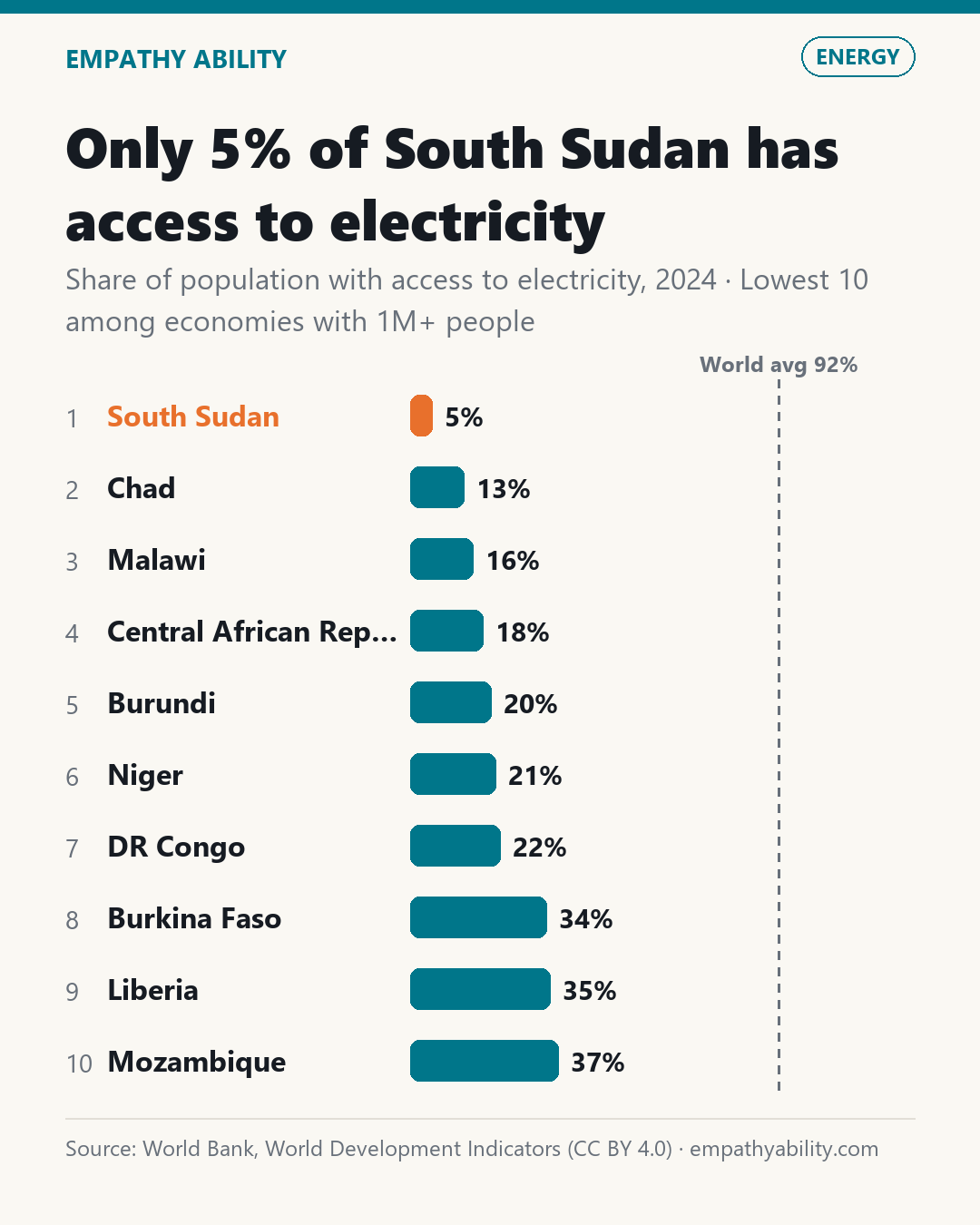
5.4% of South Sudan's population has access to electricity, the lowest rate in the world. Eight of the ten lowest rates are in Sub-Saharan Africa.
The short answer
South Sudan has the lowest electricity access in the world among economies with more than one million people: 5.4% of the population in 2024. Chad (13.4%) and Malawi (15.6%) follow. The world average is 91.9%.
The full top 10
| Rank | Country / economy | Electricity access (%) |
|---|---|---|
| 1 | South Sudan | 5% |
| 2 | Chad | 13% |
| 3 | Malawi | 16% |
| 4 | Central African Republic | 18% |
| 5 | Burundi | 20% |
| 6 | Niger | 21% |
| 7 | DR Congo | 22% |
| 8 | Burkina Faso | 34% |
| 9 | Liberia | 35% |
| 10 | Mozambique | 37% |
What the number means
This measures the share of people with access to an electricity source, including off-grid solutions, not necessarily reliable or continuous supply.
Where access is lowest
Eight of the ten lowest rates are in Sub-Saharan Africa: South Sudan, Chad, Malawi, the Central African Republic, Burundi, Niger, the Democratic Republic of Congo and Burkina Faso are all below 35%.
Why it matters
Electricity access underpins healthcare (refrigerated vaccines, powered equipment), education (lighting for study, digital learning) and economic activity. It's tracked as UN Sustainable Development Goal 7.
How we made this
Data: World Bank, World Development Indicators (indicator EG.ELC.ACCS.ZS), 2024. We compare economies with at least one million people.
Frequently asked questions
Which countries have 100% access?
Most high-income and middle-income economies report 100%, including South Korea, most of Europe, and much of East Asia and Latin America.
Is this improving over time?
Globally, yes — the world average has risen steadily over the past two decades, though the lowest-access countries have seen slower progress.